Membership update (August 2021)

When we launched the Nordic Network for Jewish Studies in January 2020, we sent out a call for academic and lay members with an interest in Jewish Studies (broadly considered) to join us in co-creating this new forum. And, we are so pleased with the responses we received! In this post we want to share with you a summary of the data we received from our membership to give you an idea of the profile, location, and interests of our Network’s members. You can read the full report here.


Summary of the responses received

As of 29 August 2021, our membership GoogleForm has received responses from 87 members based in Denmark, Finland, Norway, and Sweden (plus Israel and the UK). Of these members, 77 were affiliated with a higher education or other public cultural institution, and the remaining 10 members were unaffiliated.

A. Affiliated members

Those who indicated that they had an institutional affiliation were collectively associated with 25 higher education and cultural institutions in the Nordic region, as well as two further universities in the UK and in Israel.

Affiliated members have an incredibly wide range of academic research interests that span the full range of Jewish Studies and its subdisciplines of history, language and area studies, literature, holocaust and genocide studies, migration studies, gender and sexuality studies, contemporary Jewish communities, heritage and cultural preservation, as well as antisemitism, Jewish/non-Jewish relations and inter-faith encounters.

The teaching areas listed by affiliated members mirrored the range of subject areas seen in the research interests represented in the group, and showed also the wide-range of settings in which teaching takes place, including: full courses delivered in-person or at distance, occasional/sessional lecturing, short-courses and intensive workshops, as well as talks and events in public and community-facing settings.

Most of our members are either current or former supervisors of MA and PhD students.

B. Unaffiliated members

Those respondents who did not indicate affiliation with Higher Education institutions were asked to identify the sector they work in. The responses include: education and teaching, independent researchers, media and communications, religious institutions and in healthcare. There are also a few retired members among the unaffiliated respondents.

Our unaffiliated members listed a broad range of interests in Jewish Studies (broadly defined), including historical and contemporary Jewish communities, cultures, languages and literatures. Some members were interested in learning about Jewish Studies courses that were offered in the Nordic Region.

C. What members would like the Network to share and what they would like to share with the Network in return.

Among the 77 affiliated members, the majority of respondents wanted the Network to share research news as well as announcements of academic events (upcoming lectures, seminars, conferences, etc), but all options received strong responses. The majority of respondents in this group also wanted to be able to share their research news and academic event announcements with the Network, and again all options received a fairly even spread of responses.

Among the 10 unaffiliated members, most wanted the Network to share research news and academic event announcements, and most wanted to share announcements of non-academic events (public engagement events, etc.)

D. Final comments

Last, but not least, we would like to say a big thank you to you all for the comments you shared at the conclusion of the form. I have included a selection of these in the full report. We were so appreciative of all the enthusiasm and support expressed, and look forward to continuing to create this space together with you all.

What next?

We so appreciate all the responses we received, which will inform our activities going forward. In the meantime, we would be grateful if you might be willing to do some of the following:

  1. Read the full report to learn more about our members.
  2. Encourage those who have an interest in our activities to join our Network – whether as members or as recipients of our news by subscribing to our blog. That includes colleagues, students, members of your religious community and lay people – so long as they have an interest in Jewish Studies (broadly considered), they are more than welcome.
  3. Engage with us! Send us your news, event announcements, research project summaries, courses, and more. The data received via the membership form indicated a huge amount of interest in receiving news from other members, as well as interest among our membership to share their news with the Network. We would love to facilitate this!

The Nordic Network for Jewish Studies was founded and is run by Dr Katharina Keim and Dr Karin Zetterholm at the Centre for Theology and Religious Studies at Lund University.

Don’t forget to subscribe to our blog to receive the latest news from the Network in your email inbox! You are always welcome to get in touch with us at admin[dot]nordicjewishstudies[at]ctr[dot]lu[dot]se.

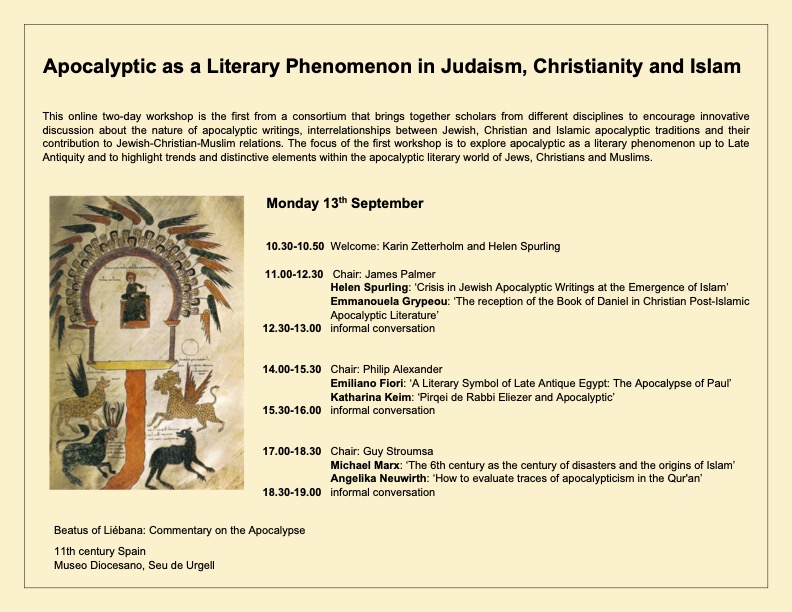
Event announcement: Apocalyptic as a Literary Phenomenon in Judaism, Christianity, and Islam, 13-14 September, online via Zoom

We are pleased to announce an upcoming workshop on the theme of Apocalyptic as a Literary Phenomenon in Judaism, Christianity and Islam.

This online two-day workshop is the first from a consortium that brings together scholars from different disciplines to encourage innovative discussion about the nature of apocalyptic writings, interrelationships between Jewish, Christian and Islamic apocalyptic traditions and their contribution to Jewish-Christian-Muslim relations.

The focus of the first workshop is to explore apocalyptic as a literary phenomenon up to Late Antiquity and to highlight trends and distinctive elements within the apocalyptic literary world of Jews, Christians and Muslims.

You can find details of the programme below and download it as a pdf here.

All are welcome! If you would like to join us for this workshop, please register via Eventbrite by 8 September 2021 at 18:00 CEST. The Zoom link for the sessions will be sent to those who have registered after this date.

If you have any questions, please do contact both Helen Spurling (Southampton) and Katharina Keim (Lund).

The Nordic Network for Jewish Studies was founded and is run by Dr Katharina Keim and Dr Karin Zetterholm at the Centre for Theology and Religious Studies at Lund University.

Don’t forget to subscribe to our blog to receive the latest news from the Network in your email inbox! You are always welcome to get in touch with us at admin[dot]nordicjewishstudies[at]ctr[dot]lu[dot]se.

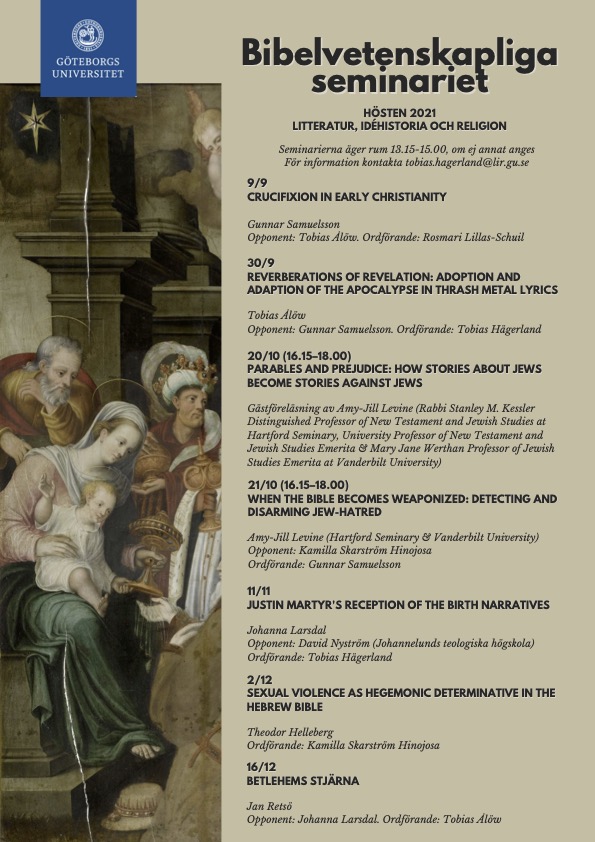
Events: Jewish Studies Seminar at Lund University, Autumn 2021

The Centre for Jewish Studies at Lund University is pleased to announce this autumn’s Jewish Studies Seminar schedule.

All meetings (except the joint seminar with History of Religions on 24 November) will take place on online via Zoom.

All are welcome! Please get in touch with Karin Zetterholm if you would like to attend in order to get access to the Zoom link as well as any pre-circulated information.

Please note regarding the times: 13–15 means that we start at 13.15 in accordance with the old Lund University custom. 9.00, by contrast, means 9.00 sharp.

DateTimeSpeaker and paper title
9/913–15Daniel Weiss, Senior Lecturer in Jewish Studies at the University of Cambridge, presents his research project, “Jesus-followers and non-minim in early rabbinic literature” and guides us through a close reading of a few tannaitic texts. Jointly with the NT seminar and Patristics.
30/915–17Daniel Leviathan, doctoral candidate at Lund University, presents the introductory chapter of his dissertation.
14/109.00–18.00 Second Nordic Postgraduate Forum in Jewish Studies
(in collaboration with the University of Tübingen)

PhD students in Jewish Studies and related areas will present their work and receive feedback.

There will also be a guest lecture by Michal Bar-Asher Siegal, Ben Gurion University of the Negev, “How much Christianity did the Babylonian Rabbis know? Rabbinic Responses to Christian Biblical Exegesis.” For registration and further info, click here.
24/1113-15Lena Roos, Södertörns högskola, presenterar sitt RJ-projekt ”Spår av jiddischkeit: Jiddischsamlingen på judiska biblioteket”. Samseminarium med religionshistoria. NB: This meeting will not take place online, and the paper will be presented in Swedish.
2/1215–17Guest lecture by Avigdor Shinan, Hebrew University of Jerusalem, on rabbinic biblical interpretation.

The Nordic Network for Jewish Studies was founded and is run by Dr Katharina Keim and Dr Karin Zetterholm at the Centre for Theology and Religious Studies at Lund University.

Don’t forget to subscribe to our blog to receive the latest news from the Network in your email inbox! You are always welcome to get in touch with us at admin[dot]nordicjewishstudies[at]ctr[dot]lu[dot]se.

News and greetings for the start of the new academic year 2021/22

So, it is that time of year again when the summer break is rapidly coming to an end and the academic year begins anew. We hope that you have all had a restful, Nordic-style summer break and that you are ready for the new term.

At the Nordic Network for Jewish Studies we feel that the new academic year presents a perfect opportunity to reiterate our invitation to you all to share your news with us.

The Network was founded with the intention of creating a platform to connect scholars in Jewish Studies and related fields from across the Nordic region and, with this in mind, we would love it if you could get in touch with us to share Jewish Studies news and events.

You may wish, for example, to:

  • showcase a specific research project,
  • outline a pedagogical tool or innovation,
  • announce a new publication, or to prepare a review of a recent publication,
  • announce (or report on) an academic event, a public engagement event or similar initiative, or
  • advertise a course.

You are welcome to write to us with the details of the item you’d like to share. You are welcome to prepare the text of your announcement (circa 500 words maximum) but, if you cannot, we can write up the information you provide. News can be shared in any of the Scandinavian languages or in English.

Your news will be shared to our blog’s subscribers (and if you aren’t yet a subscriber, please do sign up below!) and with the Network’s twitter followers (@nordicjewishst). More information about how to prepare your submission can be found on our author guidelines page.

We look forward to hearing from you! And, to sharing your news and events with the Network.

Katharina Keim and Karin Zetterholm

Centre for Theology and Religious Studies, Lund University

The Nordic Network for Jewish Studies was founded and is run by Dr Katharina Keim and Dr Karin Zetterholm at the Centre for Theology and Religious Studies at Lund University.

Don’t forget to subscribe to our blog to receive the latest news from the Network in your email inbox! You are always welcome to get in touch with us at admin[dot]nordicjewishstudies[at]ctr[dot]lu[dot]se.

Call for submissions: Nordisk judaistik/Scandinavian Jewish Studies

The peer-reviewed open access journal Nordisk judaistik/Scandinavian Jewish Studies is currently accepting submissions.

NJ aims at promoting Jewish studies in Scandinavia by publishing scholarly articles, surveys and documents, by reviewing recent literature, and compiling bibliographies. The journal is multidisciplinary and welcomes articles from a vast range of research fields within which Jewish themes are analysed, e.g. history, the study of religions, linguistics, theology, anthropology, social sciences and the arts. The journal focuses on Jewish studies in Scandinavia and research conducted by scholars tied to Nordic universities. The journal is strictly academic and does not pursue any special religious, political or cultural policy.

Articles are selected on the basis of a double blind peer-review process where two independent experts in the field review each article in a process where both the reviewer and author identities are concealed from each other.  

If you work within these research fields, we encourage you seek publications with NJ. We publish two issues a year and deadline for the up-coming spring issue is 31.03.2021, but we accept submissions continuously.

Nordisk judaistik/Scandinavian Jewish Studies is found at: https://journal.fi/nj

Focus and Scope: https://journal.fi/nj/about

Author instructions and style sheet: https://journal.fi/nj/about/submissions

Editors Ruth Illman & Svante Lundgren look forward to hearing from you.

The Nordic Network for Jewish Studies was founded and is run by Dr Katharina Keim and Dr Karin Zetterholm at the Centre for Theology and Religious Studies at Lund University.

Don’t forget to subscribe to our blog to receive the latest news from the Network in your email inbox! You are always welcome to get in touch with us at admin[dot]nordicjewishstudies[at]ctr[dot]lu[dot]se.

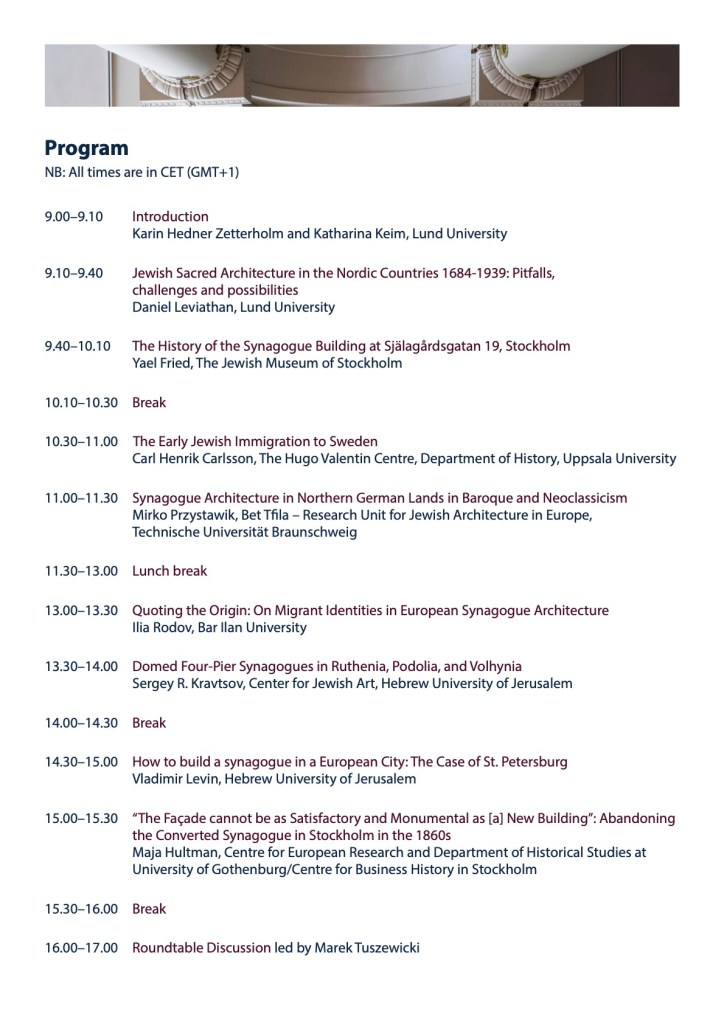
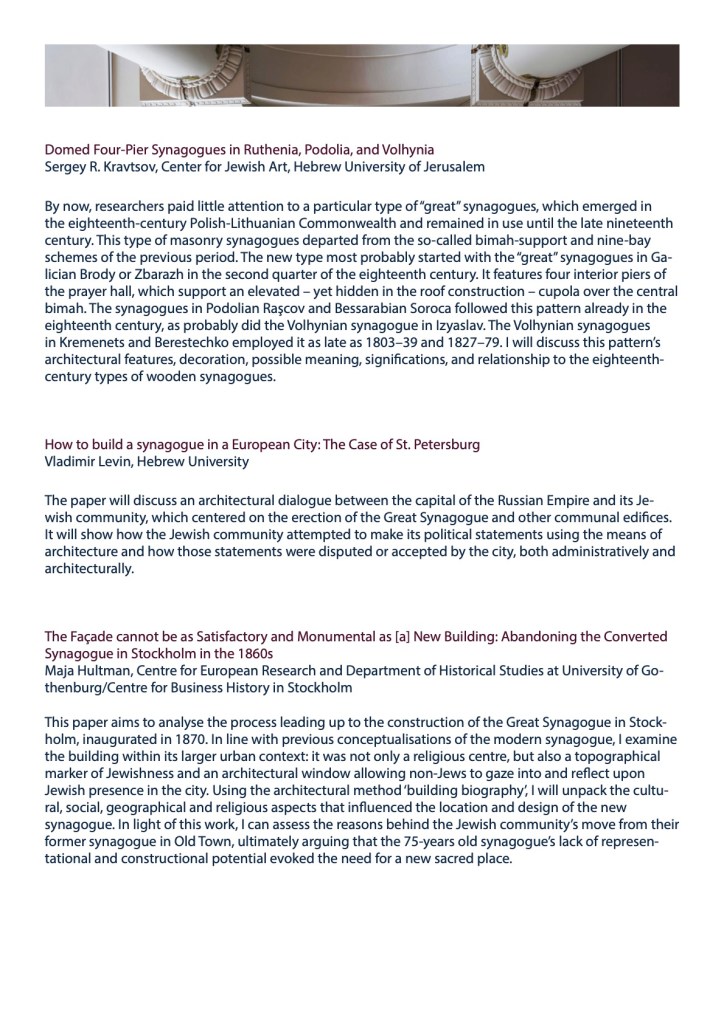
Event announcement: Symposium on Swedish Synagogue Architecture (1795–1870), 19 April 2021 via zoom

We are glad to announce an upcoming day symposium on Symposium on Swedish Synagogue Architecture (1795–1870) and the Cultural Milieu of the Early Jewish Immigrants to Sweden. The event has been co-organised by colleagues at the Centre for Theology and Religious Studies at Lund University, the University of Potsdam, and the Institute of Jewish Studies at the Jagiellonian University in Krakow.

All are welcome! If you would like to join us, please register with us in advance. The Zoom link will be circulated to those who have registered the day before the event.

The Nordic Network for Jewish Studies was founded and is run by Dr Katharina Keim and Dr Karin Zetterholm at the Centre for Theology and Religious Studies at Lund University.

Don’t forget to subscribe to our blog to receive the latest news from the Network in your email inbox! You are always welcome to get in touch with us at admin[dot]nordicjewishstudies[at]ctr[dot]lu[dot]se.

Nordisk judaistik/Scandinavian Jewish Studies issue 31/2 available now

Svante Lundgren and Ruth Illman, editors of Nordisk judaistik/Scandinavian Jewish Studies, have announced that Vol. 31/2 of the journal has been published and is available online now.


Table of contents for Vol. 31/2

Editorial
Ruth Illman, Svante Lundgren

ARTICLES
Didaktiska reflektioner om judendom, stereotyper och tankefigurer
Håkan Bengtsson

Yidishe tates forming Jewish families: Experiences of intermarried Finnish Jewish men
Mercédesz Czimbalmos

Scandinavia and Israel after the Holocaust
Orna Keren-Carmel

Svenska judars berättelser om flyktingar, överlevande och hjälpverksamheter under och efter Förintelsen
Malin Thor Tureby

BOOK REVIEWS
Judiskt liv i Helsingfors
Svante Lundgren

Minnen från ett finskjudiskt musikerliv i tradition och förändring –
Hillel Tokaziers biografi
Ruth Illman

REPORTS
Nordic Jews in the twentieth and twenty-first centuries
Dóra Pataricza

DISCUSSION
”Den som pekar på andras brister visar därigenom sina egna”
Genmäle till Pontus Rudberg
Malin Thor Tureby


Nordisk judaistik/Scandinavian Jewish Studies aims to promote Jewish studies in Scandinavia by publishing scholarly articles, surveys and documents, essays and conversations as well as by reviewing recent literature. Contributions are published in one of the Scandinavian languages, or in English, German or French, with an abstract in English. The journal is strictly academic and does not pursue any special religious, political or cultural policy. NJ is published open access online. The editors welcome submissions of articles and reviews, and can be reached at the email addresses linked above.

The Nordic Network for Jewish Studies was founded and is run by Dr Katharina Keim and Dr Karin Zetterholm at the Centre for Theology and Religious Studies at Lund University.

Don’t forget to subscribe to our blog to receive the latest news from the Network in your email inbox! You are always welcome to get in touch with us at admin[dot]nordicjewishstudies[at]ctr[dot]lu[dot]se.

Vacancies: Four salaried PhD positions, Lund University

The Centre of Theology and Religious Studies at Lund University will shortly advertise four paid PhD positions in a range of fields including Jewish Studies. Applicants will be asked to submit course transcripts, a copy of their MA thesis and a dissertation plan. The successful candidates will receive full funding for four years and will be required to spend the larger part of that time at Lund University. 

The application procedure opens on Feb. 1 and a link to the application system will appear here:  https://www.lunduniversity.lu.se/about-lund-university/work-lund-university/applying-position.

Deadline for submission is Feb. 28, 2021.

You are welcome to contact Magnus Zetterholm (Magnus.Zetterholm@ctr.lu.se) if you would like to learn more. 

The Nordic Network for Jewish Studies was founded and is run by Dr Katharina Keim and Dr Karin Zetterholm at the Centre for Theology and Religious Studies at Lund University.

Don’t forget to subscribe to our blog to receive the latest news from the Network in your email inbox! You are always welcome to get in touch with us at admin[dot]nordicjewishstudies[at]ctr[dot]lu[dot]se.

Event: Evening Lecture Series on “Jews and Health: Tradition, History, and Practice,” Centre for Jewish Studies at SOAS (online)

The Centre for Jewish Studies at SOAS, University of London is hosting an evening lecture series for 2020-21 on ‘Jews and Health: Tradition, History, and Practice’. All are welcome, but advance registration is required via eventbrite.

The programme is provided in full below. Please note that all times are in GMT.


SOAS, University of London

Centre for Jewish Studies

2020-21 

Evening Lecture Series

Chair: Prof. Catherine Hezser (HRP)

Jews and Health: Tradition, History, and Practice

In the time of Coronavirus, the preservation of health, the prevention of infection, and the healing of the sick have become our foremost concerns. The topics of health and illness play a prominent role in the Jewish tradition from the Hebrew Bible onwards. In the Book of Job, the protagonist is given advice by his friends on how to deal with the disease that afflicts him. In the Babylonian Talmud, rabbis provide medical advice in the context of Hellenistic and Persian medicine. Jewish physicians were present at the Ottoman sultan’s court. Jews also experienced epidemics such as the plague in earlier periods already and understood the need for social distancing and adjustments in religious law. This lecture series looks at health, illness, and medicine amongst Jews from antiquity until today.

The lectures will take place on Zoom on Wednesdays from 18:00-19:00h. Attendance is free of charge. Advance registration on Eventbrite (at the links provided below) is required separately for each lecture. Places are limited to 50 for each lecture. Those who have registered will receive a Zoom link a few days before the event takes place. For questions please contact the organiser at ch12@soas.ac.uk.

Wednesday 18 November 2020, 18:00-19:00h GMT: 

Prof. Katherine E. Southwood, St John’s College, University of Oxford:

“Illness in the Book of Job and the Health Advice of Job’s Friends”:

The lecture launches her recently published book, Job’s Body and the Dramatised Comedy of Moralising (London: Routledge, 2020). The book highlights the key role Job’s body plays in undermining the idea of illness as divine retribution. Job’s friends provide a wealth of moralising advice in response to his own body-centred language. In Job, the juxtaposition of bodily experience and traditional wisdom is explored in a light-hearted way, shifting from tragedy to comedy, similar to Aristophanes and Athenian theatre plays. In the dialogues, the self-righteous Job becomes ever more frustrated and this change is expressed in body-centred language.  Exaggerated metaphors of divine attack and surveillance reflect Job’s symbolic protest against retribution language. In response, his friends increase their moralising talk until the comic character Elihu suggests that the wind within constrains Job. As all the characters become increasingly vexed, the audience follows the windy discussion, knowing all along that Job is blameless.  

Katherine E. Southwood is Associate Professor of Old Testament/Hebrew Bible at the University of Oxford since 2013, after an appointment as University Lecturer at St Mary’s University College, Twickenham. Her research is interdisciplinary, using insights from Anthropology and Classical Studies. She has published three monographs and numerous articles. She is currently program unit chair of the Society for Biblical Literature’s “Social Sciences and the Interpretation of Hebrew Scriptures” unit.

Register for the lecture on Eventbrite:

Wednesday 13 January 2021, 18:00-19:00h GMT:

Prof. Mark Geller, University College London and Paris Institute of Advanced Studies:

“Forget about Galen?  Talmudic Medicine in Context”

The lecture will investigate to what extent rabbis of the Babylonian Talmud were familiar with the medicine of their era, as a reflection of larger questions regarding the extent of penetration of Hellenistic science into Babylonia.  Medicine serves as a useful barometer for the level of general scientific knowledge. Talmudic medicine can be used as a test to determine whether Babylonian rabbis were influenced by the medical writings of authorities such as Hippocrates or Galen, as is often assumed to be the case, or whether Talmudic medicine reflects other inspirations.

Mark Geller is Jewish Chronicle Professor of Jewish Studies at University College London since 1976. He is an expert on Semitic languages, including Aramaic, Akkadian, Sumerian, Ugaritic, and Arabic, and on the Babylonian Talmud. In 2005-6 he received a grant from the Wellcome Trust to work on ancient Babylonian medicine and is now working on a book on Ancient Jewish Medicine.

Register for the lecture on Eventbrite:

Wednesday 10 February 2021, 18:00-19:00h GMT:

Prof. Miriam Shefer Mossensohn, Tel Aviv University:

“Medical Reform and Jewish Reform: Two Ottoman-Jewish Physicians Around 1700”

The lecture will focus on two Jewish physicians of the Ottoman period. Refael Mordekhai Malki (d. 1702), a rabbi and physician in Ottoman Jerusalem, composed in the 1690s a vast Torah commentary in Hebrew, calling for medical reform. Tobias Cohen (d. 1729), a physician at the Ottoman Sultan’s court, published his Ma’aseh Tuviyya, “The Work of Tobias”, in Venice in 1708. It is a medical compendium with a new mechanical understanding of the human body.The lecture will investigate the mind-set of these two rather conservative and cautious scholars who, on the threshold of modernity, advocated profound changes along two axes, the Jewish-communal and medical-universal realms.

Miriam Shefer Mossensohn is Professor of Middle Eastern and African History at Tel Aviv University and Head of the Zvi Yavetz School of Historical Studies. She is an early-modern Ottomanist, focusing on Islamicate medicine, health and wellbeing. Her publications include  After Ottoman Medicine: Healing and Medical Institutions 1500-1700 (State University of New York Press, 2009) and Science among the Ottomans: The Cultural Creation and Exchange of Knowledge (the University of Texas Press, 2015). Her current research explores how medicine was managed, organized, and supervised in the Ottoman Empire of the early modern period. 

Register for the lecture on Eventbrite:

Wednesday 24 February 2021, 18:00-19:00h GMT: 

Prof. Susan L. Einbinder, University of Connecticut:

“Writing Plague: Jewish Accounts of the Great Italian Plague (1630-31)”

Lecture summary: Historians have long noted the abundance of literary responses to the Great Italian Plague of 1630-31, but little attention has been paid to Jewish sources. Nonetheless, Hebrew narrative, poetic, homiletical, and liturgical testimony exists and is important.  These texts document efforts – administrative, medical, spiritual, practical – to meet the challenge of a pandemic. But pandemic also created a textual challenge, exposing conventions of self-representation under extraordinary stress.  This talk examines several examples, asking how their authors met the challenge of “writing plague,” and how those challenges echo in our writing, too.    

Susan L. Einbinder is Professor of Hebrew and Judaic Studies and Comparative Literature at the University of Connecticut. Among her publications are After the Black Death: Commemoration and Plague among Iberian Jews(Philadelpha: University of Pennsylvania Press, 2018) and “Prayer and Plague: Jewish Plague Liturgy from Medieval and Early Modern Italy” in: Death and Disease, ed. Lori Jones and Nükhet Varlik (York Medieval Press; forthcoming). She is currently working on a book entitled, Writing Plague: Jewish Responses to the Great Italian Plague (1630-31).

Register for this lecture on Eventbrite:

Wednesday 3 March 2021, 18:00-19:00h GMT:

Dr. Daniel Staetsky, Woolf Institute, Cambridge:

“Jews and Coronavirus: The Global View of Phase 1 of the Pandemic”

The lecture surveys the impact of the first phase (March to May 2020) of the Coronavirus pandemic on Jews worldwide, comparing statistics about infection and mortality rates amongst Jews in different countries. Religious, socio-economic, and other factors that stand behind the statistics will be evaluated.

Daniel Staetsky is Senior Research Fellow at the Institute for Jewish Policy Research (JPR). He specialises in Jewish, Middle Eastern, and European demography and social statistics, especially with regard to religious and ethnic minorities. His publications include “Jewish Mortality Reconsidered” (Journal of Biosocial Science 2015), “Jews and Coronavirus in England and Wales: What the ONS Study of Covid-19 Mortality Comparing Different Religious Groups in England and Wales Tells Us About British Jewish Mortality” (JPS 2020).

Register for the lecture on Eventbrite:

Wednesday 17 March 2021, 18:00-19:00h GMT:

Prof. Joshua Teplitsky, Stony Brook University:

“Dilemmas of Disease: Jews and the Plague in Prague in the Eighteenth Century”

The lecture will examine competing pressures on Jews at the time of the plague, such as health policy, economic pressure, and the impulse to conceal disease from the civic authorities. These competing pressures appear in a variety of instances during the early modern period, and invite an investigation into the spaces of both Jewish commonality and distinctiveness, as well as Jewish self-perception during the plague, and questions of compliance vis-a-vis the state and social norms — issues that are exceedingly relevant again nowadays.

Joshua Teplitsky is Associate Professor of History at Stony Brook University, New York. His work focuses on Jewish life in the Habsburg Empire in the early modern period (16th–18th centuries), with an emphasis on the city of Prague. His publications include “Plague, Passover, and Perspectives on Social Distancing”, Magazine of the Institute for Israel and Jewish Studies Spring 2020; “A Conversation Between Joshua Teplitsky and Magda Teter about Epidemics, Disease and Plagues in Jewish History & Memory” (April 22, 2020).

Register for this lecture on Eventbrite:

The Nordic Network for Jewish Studies was founded and is run by Dr Katharina Keim and Dr Karin Zetterholm at the Centre for Theology and Religious Studies at Lund University.

Don’t forget to subscribe to our blog to receive the latest news from the Network in your email inbox! You are always welcome to get in touch with us at admin[dot]nordicjewishstudies[at]ctr[dot]lu[dot]se.

Event announcement: “Antisemitism or Anti-Judaism? Jews and non-Jews in Interwar Poland”, Sunday 22 Nov (online via zoom)

This Sunday 22 November Magdalena Dziaczkowska, a doctoral student at the Centre for Theology and Religious Studies at Lund University and a visiting research fellow at the Hebrew University of Jerusalem, will present an online seminar on “Antisemitism or Anti-Judaism? Jews and non-Jews in Interwar Poland.”

For further details, including the zoom link, see the poster below.

The Nordic Network for Jewish Studies was founded and is run by Dr Katharina Keim and Dr Karin Zetterholm at the Centre for Theology and Religious Studies at Lund University.

Don’t forget to subscribe to our blog to receive the latest news from the Network in your email inbox! You are always welcome to get in touch with us at admin[dot]nordicjewishstudies[at]ctr[dot]lu[dot]se.