This is a reminder that there is an event this afternoon in Lund: please click here to go to the original post.
LUND: The Binding of Isaac and Jewish-Christian Relations 13/2 2025
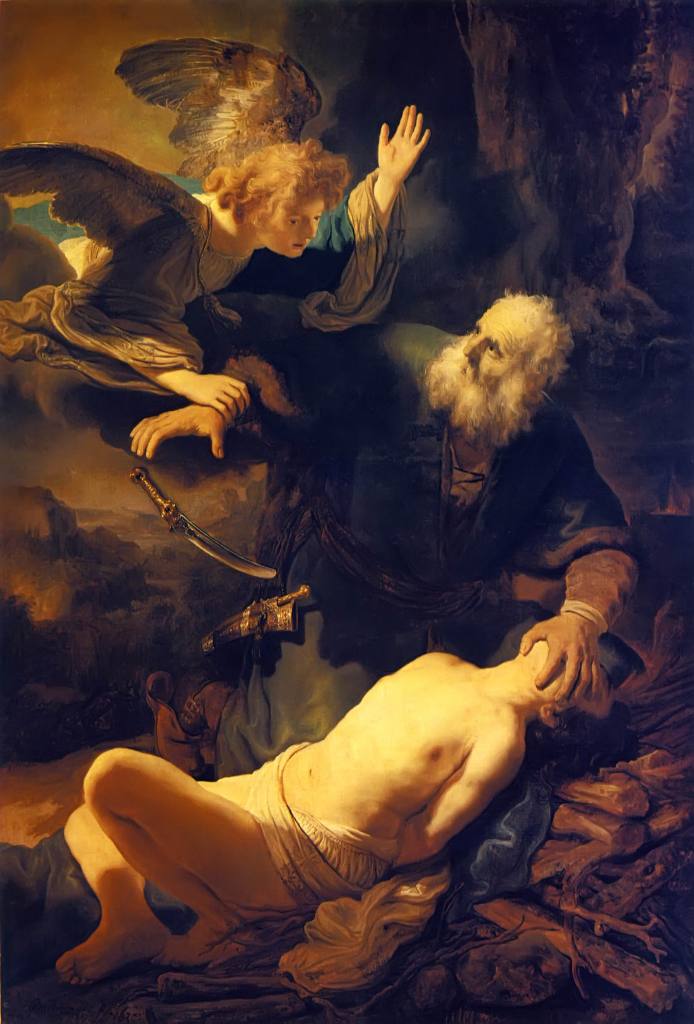
Dr. Karin Zetterholm (Senior Lecturer, Associate Professor in Jewish Studies at CTR) and Dr. Oren Roman Cohen (Senior Lecturer, Associate Professor in Yiddish at SOL) present “The Binding of Isaac (Aqedah) and Jewish–Christian Relations: The Aqedah in Text and Art from Antiquity through the Early Modern Period.”
We meet the 13th of February 2025 at 15–17, in LUX B:212. Please note that there is no Zoom option.

Image courtesy of Sefaria, original artwork by Rembrandt Harmenszoon van Rijn (1606-1669).
LUND/Zoom: “On Mystery and (not) Knowing in the Encounter” 6/2 2025
PhD student Jordan Jacobs presents a part of his thesis, “On mystery and (not) knowing in the encounter: an exploration parting from Abraham Joshua Heschel.” Jointly with the seminar on Philosophy and Ethics.
We meet 6th of February at 16–18 (NB the time!) in LUX B:417 in Lund and on Zoom.
Please contact Jordan Jacobs (jordansp@ucm.es) to get the material in advance and preregister for Zoom.
[REMINDER] Stockholm: Doktoranddag
Vänlig påminnelse om att sista anmälningsdagen för Doktoranddagen 5/12 i Stockholm är imorgon, torsdag 21/11. Läs mer på denna föregående post: STOCKHOLM: Doktoranddag
STOCKHOLM: Doktoranddag
Välkommen till Södertörns högskola den 5 december för en dag för doktorander som sysslar med judendomsrelaterade ämnen!
Huvuddelen av dagen består i att alla som vill får tillfälle att presentera något från sitt pågående avhandlingsprojekt. För nyantagna kan det vara att presentera själva projektet; för doktorander som kommit längre kan det vara något av resultaten eller någon fråga man särskilt vill få feedback på. Räkna med att din presentation ska vara ca 15 minuter.
Dagen kommer att se ut som följer:
10-11.30 Presentationer av pågående forskning
11.30-12.30 Lunch
12.30-14.30 Presentationer av pågående forskning
14.30-15 Kaffe
15-16.30 Seminarium om filosofen Hermann Cohen. Dana Hollander, associate professor, Religious studies, McMaster University, kommer att inleda seminariet. Hon har bland annat publicerat boken Ethics Out of Law: Hermann Cohen and the “Neighbor” (University of Toronto Press, 2021). Under seminariet kommer vi att gemensamt diskutera någon av Cohens texter.
Cohen är en av de centrala tänkarna för det nystartade projektet Experimenting With Traditions: The Life and Afterlife of 20th Century Jewish Intellectual Culture in the Baltic Sea Region. Projektet bedrivs i samverkan mellan filosofi och religionsvetenskap. Nytt projekt undersöker mötet mellan traditionellt judiskt tänkande och västerländsk upplysningsfilosofi – Södertörns högskola
Om Dana Hollanders bok:
Hermann Cohen (1842–1918) was a leading figure in the Neo-Kantian philosophical movement that dominated European thought before 1918. He is also the inaugural figure for what is meant by “modern Jewish philosophy” in the twentieth and twenty-first centuries. This book explores Cohen’s striking claim that ethics is rooted in law – a claim developed in both his philosophical ethics and his philosophy of Judaism, in particular in his writings on “love-of-neighbor,” up to and including his well-known Religion of Reason.
Dana Hollander proposes that neither Cohen’s systematic philosophy nor his “Jewish” philosophy should be seen as the dominant framework for his oeuvre as a whole, but that his understanding of key philosophical questions takes shape in the passages between both corpuses, a trait that could be seen as paradigmatic for modern Jewish philosophy. Ethics Out of Law taps into one of the prime topics of current interest in the field of Jewish philosophy: the nature of Jewish political existence and the changing configurations of “law” that this entails.
Anmäl dig till doktoranddagen på denna länk, klicka här för att komma dit eller copy-paste https://axacoair.se/go?q9AyfAWU. Ange där om du vill delta med eller utan presentation. Deadline för anmälan: Torsdag 21 november.
Ansvarig för event: Lena Roos Professor i Religionsvetenskap på Södertörns Högskola vid Institutionen för historia och samtidsstudier. Email för kontakt: lena.roos@sh.se
Follow up on Post Graduate Conference, Lund, 16th-17th of September 2024
A few weeks back, a Post Graduate Conference was arranged in Lund – see this post for previous information. Here’s the summary from the organisers, including the message from us.
UCL Hebrew and Jewish Studies and Scandinavian Studies & Lund University Centre for Theology and Religious Studies have had the pleasure to host a postgraduate conference on Jewish Studies in the Nordics, in beautiful Lund with significant hybrid participation, this 16-17 September 2024.
The conference has received generous funding from the CEMES (Centre for Modern European Studies, University of Copenhagen) as well as Oscar och Signe Krooks stiftelse and Birgit och Sven Håkan Ohlssons fond.
We have gathered 14 postgraduate presenters and a total of 20 speakers from 7 countries, including various disciplines, levels of study, backgrounds and expertise – to share their work and foster an academic environment in our diverse, and fast-developing field.
On the first day, we had the pleasure to welcome Prof Lily Kahn, Head of Department at UCL Hebrew and Jewish Studies & Dr Riitta Valjärvi, Associate professor at UCL SSEES and Uppsala University, as keynote speakers. Lily and Riitta introduced language use among Jews in Finland.
On the second day, we had the pleasure to welcome Dr Jon Reitan, Associate professor at NTNU as keynote speaker. Jon presented his ongoing project on Jewish migration history from the Baltic shtetls to Norway in the late 19th century.
We have had a variety of sessions on studying, teaching, and publishing Jewish Studies in the Nordics, with an introduction to the journal Nordisk Judaistik/Scandinavian Jewish Studies and the existing Nordic Jewish Studies Network.
We are positive about the way forward, and hope that the meaningful connections made over the last 2 days will result in exciting collaborations.
What happens next?
Nordic Jewish Studies network: we encourage you to check out the Nordic Jewish Studies Network website, where you can make a contribution by posting short blogs about your research journey, and advertise calls for papers: https://nordicnetworkforjewishstudies.com. Contact Desirée Lind for more information (de1304li-s@student.lu.se), and find her original message in the end of this email.
We plan to keep our community in the loop and update on similar initiatives, like conferences and publications in the future. When you are doing or coming across something relevant, do not hesitate to share with us.
At this stage, we are excited to bring to your attention a virtual seminar for researchers of Jewish Studies in the Nordic region, which is planned to take place in mid-November 2024. A seperate message with description will follow, please contact Paula.caceres@socwork.gu.se for more information.
Output: We are looking into the possibility of publishing papers from the conference in the journal Nordisk Judaistik. At this stage we can encourage you to think of this prospect for your work and keep your eyes open for possibilities.
Particularly, the topic of teaching Jewish Studies in the Nordic region has caught good interest during the conference. Those who wish may check with Matthew Johnson, Joanna Spyra and Maja Hultman regarding the possibility of producing an output for this topic.
We wish you all the best going forward!
Shabbat Shalom and god helg,
Noa and Magdalena.
—
Desirée Lind’s message regarding the Nordic Jewish Studies Network:
“The Nordic Network for Jewish Studies is a research network for Jewish and Jewish adjacent studies in the Nordic region and/or regarding the Nordic milieu. We do this, primarily, through our website. The idea is to build a hub with short abstracts on the current research and create a network for researchers: the aim is to shine a light on what Jewish and Jewish-adjacent studies do in the Nordic region and to foster contact across institutional borders. Here is a link to the website (which is currently under redesign so please, mind the sparsity of it): https://nordicnetworkforjewishstudies.com/
So, I’d like to 1. do a shameless plug, i.e., please feel free to check it out and sign up for the network – it’s free! and 2: shamelessly use this platform to call for papers. The concept is fairly simple: the goal is to, once a week, publish an abstract of about 500 words. The form is fairly free, as long as it includes a title, contact information for the intellectual owner of the abstract (i.e., you as its creator), and said abstract. It serves mostly as a catalogue for current research to showcase and strengthen our research areas. Please do not hesitate to reach out if you have any questions!
We also make “ads” for events, so if you have information about a seminar, course, event, etc. that you’d like to get advertised, please feel free to reach out! In that case, I need a where (zoom events are of course also welcome), when (date and time), a short description of how and why (a few sentences on what it entails), and contact information for the one organising it. A picture is also appreciated, but not a must. This is, of course, completely free.
If I’ve missed anyone on this list or you have someone else in mind that you think would like to partake in this, please feel free to send this on to them: regardless if it’s a student or a professor, we welcome all contributions to showcase how diverse our field is. Of course, we take precautions to keep our Jewish fellows safe, which includes but is not limited to not publishing the exact places for events, not freely giving out contact information that is not consented to, and manually filtering through comments and other forms of contact.
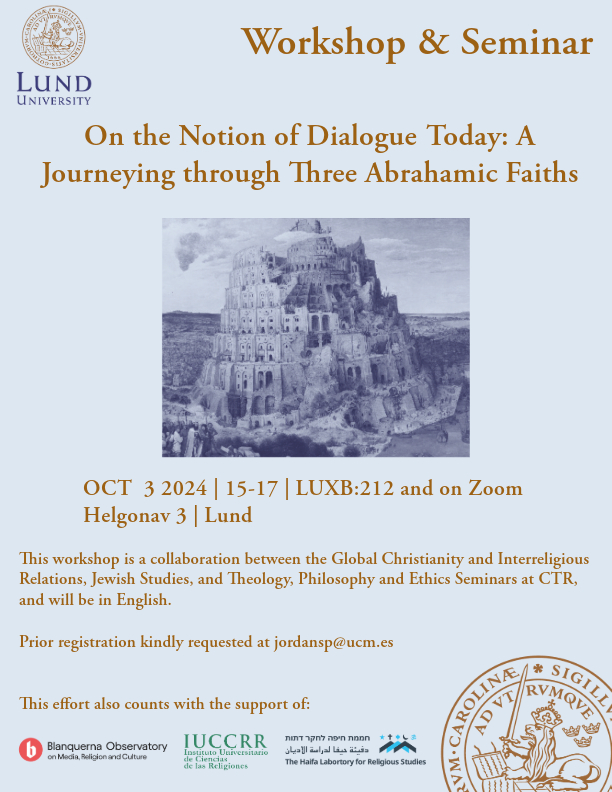
[Reminder] LUND/ZOOM: On the Notion of Dialogue Today
Get us on your Facebook feed!
Introducing Nordic Network for Jewish Studies – this time on Facebook!
Right now you’re on our website but now, we have a Facebook page! This website will still be our main platform, however, the aim is to show up in your feed, thus increasing our visibility and your access to the material.
The Nordic Network for Jewish Studies is a research network for Jewish and Jewish-adjacent studies, aiming to connect scholars, create discussion, and increase the value of our fields in the current research climate. The aim is to create a hub for the latest research, teaching, events, courses, and other related objectives and, of course, through that show off what we as researchers do.
Find us by clicking on this link, or by searching for “Nordic Network for Jewish Studies”. Please drop by and give us a follow to always have access to our material in your feed.
Over the Deep and the Face of the Water
A Recontextualization of the Study of Literary Parallels, Ancient Scholarship, and Conceptual Autonomies.
Magnus Arvid Boes Lorenzen holds a bachelor’s degree is in Assyriology, however, he also has extensive experience in Anthropology, Arabic language, and Medieval and Modern Middle Eastern history, all from the University of Copenhagen. He holds a master’s degree from the Nordic Religious Roots of Europe programme, and his primary research interests are in “the middle-grounds” between Biblical studies and Assyriology, and trying to find new, constructive, interdisciplinary approaches in and between these fields. Below you find an abstract of his thesis, and at the bottom of this page, various links where you can find more of his work.
In Genesis 6-9, we meet Noah, a patriarch who survived the great Flood sent by God, by building the ark, according to God’s commandment, to house his family and all the various animals of the earth. Towards the end of the Epic of Gilgamesh, on the eleventh tablet, we hear about Utnapishtim, an ancient, immortalized man, who survived the great Flood sent by the gods, by building a grand boat with instructions from Ea, the god of Wisdom, and bringing with him his family, various craftsmen, precious metals, and animals of the earth.
In Exodus 1-2, we hear about Moses’ birth in Egypt to anonymous Levite parents, who must let him go due to the pharaoh’s orders to kill every newborn Hebrew boy. He is set upon the Nile in a pitched reed basket, discovered by the Pharao’s daughter, fetched by her servants, and raised by midwives before being adopted into the royal palace, eventually being chosen by God to lead his people out of Egypt, to freedom and greatness. In the Sargon Legend, we encounter Sargon, ancient king of Akkad, and hear of his birth to an unknown father and an anonymous high priestess, forbidden from bearing child. His mother sets him on the Euphrates in a pitched reed basket, and he is discovered by a gardener, raised in court, eventually being favoured by the goddess Ishtar, becoming a great king, and performing legendary deeds throughout his life.
Why are these texts examples so similar? As a closer look will reveal, not all is as it seems. Parallels between Biblical and ancient Mesopotamian literature have been noted and commented on for centuries, both in religious communities, popular culture, and in academia. Yet the relationship between the disciplines that study these literary traditions, the various Biblical scholarships, and Assyriology, has been marked by strain, reservation, ideology, trauma, and even death and war. In this thesis, I show a way to reapproach these intriguing parallels, attempting to navigate the mistakes of past scholarship. Each text has its own value, context, and autonomy, and we cannot simply rely on one to explain the other. I encourage a comparative approach which takes this realization seriously, while also taking seriously the parallels between the texts, as they can hardly be considered entirely coincidental. What I hope to show with this thesis, using the parallels in Genesis-Gilgamesh and Sargon-Moses as examples, is a more constructive way forward between the diverse disciplines of Assyriology and Biblical scholarship, and a suggestion for much closer collaboration and intimacy with each other’s methodologies, languages, and texts.
Working with this thesis made several trajectories of further research stand out to me, which I am currently thinking about how to move on with. Ideas include tracing potential ancient Babylonian practises and ideas in the Babylonian Talmud, as well as a comparison of the theology surrounding the Babylonian gods Marduk and Nabû in the late 1 st millennium CE to binitarian and early Christian theologies. Both of these ideas I came upon while researching for my master’s thesis, and a discussion of the potential for the former idea is given in the thesis itself. My re-edited and improved thesis, as well as other essays on the topics discussed here, such as one early exploratory one on Nabû, Marduk, and Logos theology, can be found on my Substack-blog. I hope to be able to combine research interests with my passion for public dissemination.
Further reading:
Blog with serialized, re-edited thesis:
https://magnusarvid.substack.com/s/the-thesis-series
The original thesis, from the Royal Library of Copenhagen:
https://soeg.kb.dk/permalink/45KBDK_KGL/1pioq0f/alma99125666103505763
An early essay exploring the idea of comparing Nabû-theology to the surrounding religious landscape in the late 1st millennium BCE:
https://magnusarvid.substack.com/p/the-father-and-the-son-in-the-tower
Boes Lorenzen, Magnus Arvid. 2024. “Divine and Conquer: Ancestors, Gods, and the Right to Rule”. In (editors Drewsen, Anne; Poulsen, Anne; Sletterød, Marie D.) Chronolog Journal, Issue 2. Royal Library of Denmark: Tidsskrift.dk. Pp. 47-59. https://tidsskrift.dk/Chronolog/issue/view/11055
COURSE: Jewish and Christian Bible Translations. LUND/Zoom
Next term, starting in January of 2025, SOL (Språk och Litteraturcentrum at Lund University) will give a course on the history of translations of the Hebrew Bible, known to Christians as the Old Testament. This course will focus on Yiddish translations but also work with German, English, and Swedish renditions, especially shining a light on cultural-historical contexts and processes. The course is given in English as a hybrid course and students are not required to know the aforementioned languages to partake.
Read more on the Lund University webpage, click here to get there or scan the QR code below. If you have questions, please email Susan Hydén: susan.hyden@sol.lu.se.
Please note: admission closes 15th of October.