Over the Deep and the Face of the Water

A Recontextualization of the Study of Literary Parallels, Ancient Scholarship, and Conceptual Autonomies.

Magnus Arvid Boes Lorenzen holds a bachelor’s degree is in Assyriology, however, he also has extensive experience in Anthropology, Arabic language, and Medieval and Modern Middle Eastern history, all from the University of Copenhagen. He holds a master’s degree from the Nordic Religious Roots of Europe programme, and his primary research interests are in “the middle-grounds” between Biblical studies and Assyriology, and trying to find new, constructive, interdisciplinary approaches in and between these fields. Below you find an abstract of his thesis, and at the bottom of this page, various links where you can find more of his work.

 
In Genesis 6-9, we meet Noah, a patriarch who survived the great Flood sent by God, by building the ark, according to God’s commandment, to house his family and all the various animals of the earth. Towards the end of the Epic of Gilgamesh, on the eleventh tablet, we hear about Utnapishtim, an ancient, immortalized man, who survived the great Flood sent by the gods, by building a grand boat with instructions from Ea, the god of Wisdom, and bringing with him his family, various craftsmen, precious metals, and animals of the earth.

In Exodus 1-2, we hear about Moses’ birth in Egypt to anonymous Levite parents, who must let him go due to the pharaoh’s orders to kill every newborn Hebrew boy. He is set upon the Nile in a pitched reed basket, discovered by the Pharao’s daughter, fetched by her servants, and raised by midwives before being adopted into the royal palace, eventually being chosen by God to lead his people out of Egypt, to freedom and greatness. In the Sargon Legend, we encounter Sargon, ancient king of Akkad, and hear of his birth to an unknown father and an anonymous high priestess, forbidden from bearing child. His mother sets him on the Euphrates in a pitched reed basket, and he is discovered by a gardener, raised in court, eventually being favoured by the goddess Ishtar, becoming a great king, and performing legendary deeds throughout his life.

Why are these texts examples so similar? As a closer look will reveal, not all is as it seems. Parallels between Biblical and ancient Mesopotamian literature have been noted and commented on for centuries, both in religious communities, popular culture, and in academia. Yet the relationship between the disciplines that study these literary traditions, the various Biblical scholarships, and Assyriology, has been marked by strain, reservation, ideology, trauma, and even death and war. In this thesis, I show a way to reapproach these intriguing parallels, attempting to navigate the mistakes of past scholarship. Each text has its own value, context, and autonomy, and we cannot simply rely on one to explain the other. I encourage a comparative approach which takes this realization seriously, while also taking seriously the parallels between the texts, as they can hardly be considered entirely coincidental. What I hope to show with this thesis, using the parallels in Genesis-Gilgamesh and Sargon-Moses as examples, is a more constructive way forward between the diverse disciplines of Assyriology and Biblical scholarship, and a suggestion for much closer collaboration and intimacy with each other’s methodologies, languages, and texts.

Working with this thesis made several trajectories of further research stand out to me, which I am currently thinking about how to move on with. Ideas include tracing potential ancient Babylonian practises and ideas in the Babylonian Talmud, as well as a comparison of the theology surrounding the Babylonian gods Marduk and Nabû in the late 1 st millennium CE to binitarian and early Christian theologies. Both of these ideas I came upon while researching for my master’s thesis, and a discussion of the potential for the former idea is given in the thesis itself. My re-edited and improved thesis, as well as other essays on the topics discussed here, such as one early exploratory one on Nabû, Marduk, and Logos theology, can be found on my Substack-blog. I hope to be able to combine research interests with my passion for public dissemination.
 
Further reading:

Blog with serialized, re-edited thesis:
https://magnusarvid.substack.com/s/the-thesis-series
 
The original thesis, from the Royal Library of Copenhagen:
https://soeg.kb.dk/permalink/45KBDK_KGL/1pioq0f/alma99125666103505763
 
An early essay exploring the idea of comparing Nabû-theology to the surrounding religious landscape in the late 1st millennium BCE:
https://magnusarvid.substack.com/p/the-father-and-the-son-in-the-tower

Boes Lorenzen, Magnus Arvid. 2024. “Divine and Conquer: Ancestors, Gods, and the Right to Rule”. In (editors Drewsen, Anne; Poulsen, Anne; Sletterød, Marie D.) Chronolog Journal, Issue 2. Royal Library of Denmark: Tidsskrift.dk. Pp. 47-59. https://tidsskrift.dk/Chronolog/issue/view/11055

COURSE: Jewish and Christian Bible Translations. LUND/Zoom

Next term, starting in January of 2025, SOL (Språk och Litteraturcentrum at Lund University) will give a course on the history of translations of the Hebrew Bible, known to Christians as the Old Testament. This course will focus on Yiddish translations but also work with German, English, and Swedish renditions, especially shining a light on cultural-historical contexts and processes. The course is given in English as a hybrid course and students are not required to know the aforementioned languages to partake.

Read more on the Lund University webpage, click here to get there or scan the QR code below. If you have questions, please email Susan Hydén: susan.hyden@sol.lu.se.

Please note: admission closes 15th of October.

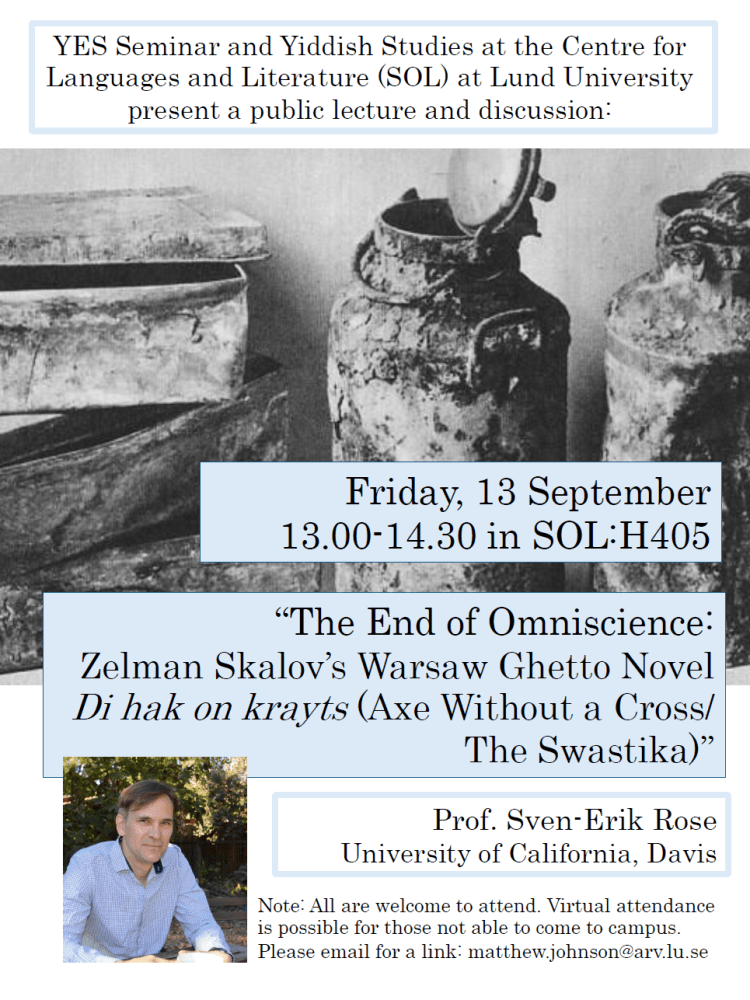
[Reminder] LUND/ZOOM: The End of Omniscience: Zelman Skalov’s Warsaw Ghetto Novel Di hak on krayts (Axe Without a Cross/ The Swastika)

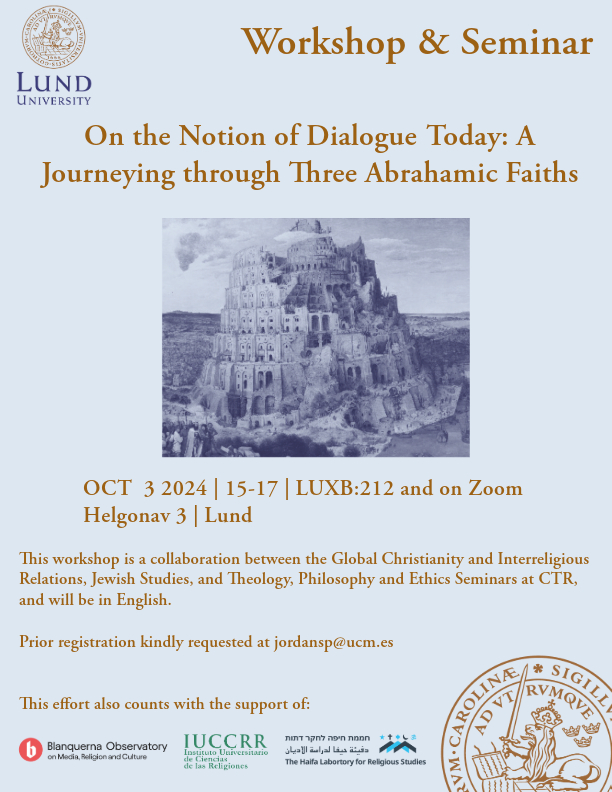
LUND/Zoom: On the Notion of Dialogue Today: A Journeying through Three Abrahamic Faiths

Join us 15-17.00 3rd of October in the workshop and seminar “On the Notion of Dialogue Today: A Journeying through Three Abrahamic Faith”, led by Jordan Spencer Jacobs, visiting PhD student.

In an era marked by polarization, the civil exchange of contrasting views appears to be at a crossroads. Accepting such a premise at face value, what insights may we glean from the three Abrahamic faith traditions, and particularly, what may they suggest about “dialogue,” “disagreement,” and “difference” today? To explore such questions, in this Seminar and Workshop we will study short textual excerpts together from the three Abrahamic faiths, and when appropriate, brief selections from more “secular” and contemporary philosophical thinkers.  This Workshop will be in English and will be held in person and also via Zoom.  To register please write to jordansp@ucm.es.  Short, optional, readings will be provided via email.

The workshop is in collaboration between the Global Christianity and Interreligious Relations, Jewish studies, and Theology, Philosophy, and Ethics seminars at Centre for Theology and Religious Studies at Lund University, and the Blanquerna Observatory on Media, Religion and Culture, lUCCRR: lnstituto Universitario de Ciencias de las Religiones, and The Haifa Labortory for Religious Studies.

Lund/Zoom: Postgraduate Conference on Jewish Studies in the Nordic Countries – schedule posted

CTR together with the UCL Hebrew and Jewish Studies organises a hybrid conference for postgraduate students working in the area of Jewish Studies in Nordic countries, 16th of September 2024 09:00 to 17th of September 2024 19:00. For more information, click here. The call for papers is closed, but you can still register for participation.

If you have questions or concerns, please contact the organisers Noa Ben-David (uclhben@ucl.ac.uk) and Magdalena Dziaczkowska (magdalena.dziaczkowska@ctr.lu.se).

LUND: The End of Omniscience: Zelman Skalov’s Warsaw Ghetto Novel Di hak on krayts (Axe Without a Cross/ The Swastika)

Please join us for an event with Prof. Sven-Erik Rose, who will soon be visiting Lund from the University of California, Davis. Erik will give a public lecture on Friday, 13 September, 13.00-14.30 in SOL:H405. The talk will be followed by opportunities for questions.

The talk is titled “The End of Omniscience: Zelman Skalov’s Warsaw Ghetto Novel Di hak on krayts (Axe Without a Cross/ The Swastika).” It is based on his forthcoming book about Yiddish literature produced in ghettos and camps during the Holocaust.

For people interested in participating but unable to attend on campus, there will be a virtual option (please email Matthew Johnson for a Zoom link, ideally at least one hour before the event begins).

Please click here to read more on professor Rose’s research

LUND: Jewish Studies Lunch

Are you in the area around Lund and wish to get more involved in the Jewish Studies network at Lund University? We gather a few times per semester to very informally share our lunch hour, primarily to socialise but also to discuss any questions that may arise, and we’d like to invite you to join us! Your educational level does not matter as we are everything from BA students to associate professors, and neither does your academic interest as long as it pertains to something Jewish: we are interested in everything from rabbinic texts to Jewish music, teachers of modern Hebrew and Yiddish to students of second temple Judaism. Please email Karin Zetterholm to sign up and find out more: please remember to not share the location for the safety of our Jewish participants, and as this is a strictly informal event. Below, you find the dates for this semester and you are welcome to join all and any of them.

Sept 19th 12-13

Oct 8th 12-13

Nov 12th 12-13

Dec 10th 12-13

We look forward to seeing you there!

Postgraduate Conference on Jewish Studies in the Nordic Countries – OBS change of the dates!

Conference 16 September 2024 09:00 to 17 September 2024 19:00

 We encourage creative proposals centering on Jewish ideas, objects, individuals, and communities in the broad Nordic region. Call for papers is open until June 21, 2024.

CTR together with the UCL Hebrew and Jewish Studies organize a hybrid conference offering an opportunity for postgraduate students working in the area of Jewish Studies in Nordic countries to engage in meaningful discussions, form a network, and present their research. The event is an interdisciplinary conference dedicated to the study of Jewish histories, cultures, and languages across the Nordic region. 

The past few years have seen a growing recognition in the academic community of the need for intellectual forums which can be accessed irrespective of location or financial means. Our event will meet this demand, providing an online platform where postgraduate and early career researchers working on some aspect of Jewish life in Scandinavia can build connections and share research in a fruitful and encouraging environment. You can register to the conference here.

This year’s pilot will be completely live and online, comprising panels of 20-minute papers and discussion. We seek to bring together researchers from across departments and universities, to form a sense of fellowship in our interdisciplinary field. To help participants meet and connect with one another, the event will offer plenty of opportunities for virtual socialising. 

Our key note speakers will be: Prof. Lily Kahn, Dr. Riitta Valijärvi, UCL and Dr. Jon Reitan, NTNU.

We encourage creative proposals centring on Jewish ideas, objects, individuals, and communities in the broad Nordic region. Areas of interest include, but are not limited to:

  • Early and modern histories and cultures 
  • Linguistics and languages 
  • Literatures and communication
  • Sociological approaches to Jewish integration and identifications 
  • Transnational perspectives

Please submit a 200 word abstract and a short biographical note to Noa Ben-David (uclhben@ucl.ac.uk) and Magdalena Dziaczkowska (magdalena.dziaczkowska@ctr.lu.se) by June 21, 2024. Feel free to get in touch with either one of us, if you have any questions.

Please note the change of the dates of the conference!

The Dynamics of Law and Narrative: Talmudic Hermeneutics in Benjamin’s Kafka

Bat Chen (Laila) Seri, PhD student at Lund University

Walter Benjamin’s reading of Franz Kafka—laid out in three essays and many additional fragments—is replete with references to Jewish literature, from citations of alleged talmudic passages and hasidic stories to invocations of rabbinic categories. On one such notable occasion, Benjamin characterises Kafka’s works as bearing “a similar relationship to doctrine [Lehre] as the haggadah does to the halakhah.” Benjamin’s comment sets the stage for this research project, which addresses the dynamics of law and narrative in Benjamin’s reading of Kafka by setting it against the backdrop of rabbinic hermeneutics. Through contemporary rabbinic literary studies, the talmudic text is taken as a model for Benjamin’s reading of Kafka in two separate but interconnected aspects: methodically, addressing modes of reading and interpretation, and conceptually, focusing on the categories of law (halakhah) and narrative (haggadah). Viewed as talmudic hermeneutical practice, midrash has several unique characteristics, thus dictating a certain, and at times eccentric, way of thinking. Midrashic methods include the utilisation of fiction as an interpretive tool (Boyarin 2003), the exchange of one story for another of equal significance, a kind of textual barter (Boyarin 2011), and the use of imagery concepts instead of abstract concepts in a way that resembles literary texts more than legislative systems (Handelman 1982). Both Kafka and Benjamin, as scholars have pointed out (Boyarin 1990, Alter 1991, Handelman 1991, Steiner 2003, Miron 2019), show some close affinities with talmudic methods of reading, a tendency which comes to full fruition in Benjamin’s reading of Kafka, where we find the interpretive exchange of stories, the use of imagery concepts in place of abstractions, and the view of the text as a boundless repertoire of quotations, where every bit of text may be torn out of its original context as parole and be used as langue. This research project aims to show how the literary study of Talmud can serve as a guide on how to read Benjamin on Kafka and illuminate hitherto hidden aspects in the thought of two of the most thought-provoking voices of twentieth-century European Jewry on issues of law, literature, and Jewish tradition.

Would you like an abstract of your research published here? Here are our Author Guidelines! We happily welcome your contribution.

Jewish-Catholic Intermarriage in Poland Before, During and After the Holocaust

Magdalena Dziaczkowska, Postdoctor at Lund University

The purpose of the study is to understand how Jewish-Catholic couples experienced in everyday life being in a mixed marriage in a period of intense intergroup tensions (antisemitism and the Holocaust), and this purpose could be divided into five aims. Firstly, to understand the internal dynamic of a mixed couple in times of conflict. Secondly, to describe the differences in the experience of men and women and their gender roles in this setting. Thirdly, to grasp the relation of the spouses to their respective ingroups and then, their relation to the outgroup (their spouse’s group), both considering the gender factor. Finally, the study seeks to assess the influence of these couples on intergroup relations in their environments, as previous research suggests intermarriage is one of the most powerful tools in overcoming intergroup prejudice and tensions. These questions are considered in the timeframe of 1930’s until 1950’s, thus, the period directly preceding, encompassing, and following the Holocaust. The study will follow the experiences of these couples throughout the entire period (the chronological aspect being crucial), and will be limited to the Polish citizens, who either stayed in Poland or left for Sweden, Israel after the war. Specific research questions following these aims are:

  • What were the cultural and religious views on intermarriage that impacted the experience of the couples?
  • How were men and women treated when engaging in heterogamy? Why? How did it change over time?
  • Did intermarriage help Jewish Poles to survive the Holocaust? If so, how? 
  • What was the impact of these relationships on the respective ingroups?
  • What changed in the perceptions of the individuals in mixed couples regarding the outgroup? How was it related to the Holocaust? What other factors mediated the change?
  • What do these findings tell us about how mixed couples navigate intergroup conflict and violence? How can the findings be translated into contemporary multicultural, minority-majority communities today? What does it suggest about the gendered experiences of mixed marriage in general?

The project is realized within the framework of an International Postdoc financed by the Swedish Research Council. The administrating institution is Centre for Theology and Religious Studies at Lund University and the host institutions are: Hebrew University of Jerusalem, University of Haifa, Jagiellonian University, and Inez and Julius Polin Institute for Theological Research at Åbo Akademi.

Would you like an abstract of your research published here? Here are our Author Guidelines! We happily welcome your contribution.