See previous post for more information, please click here to find it.

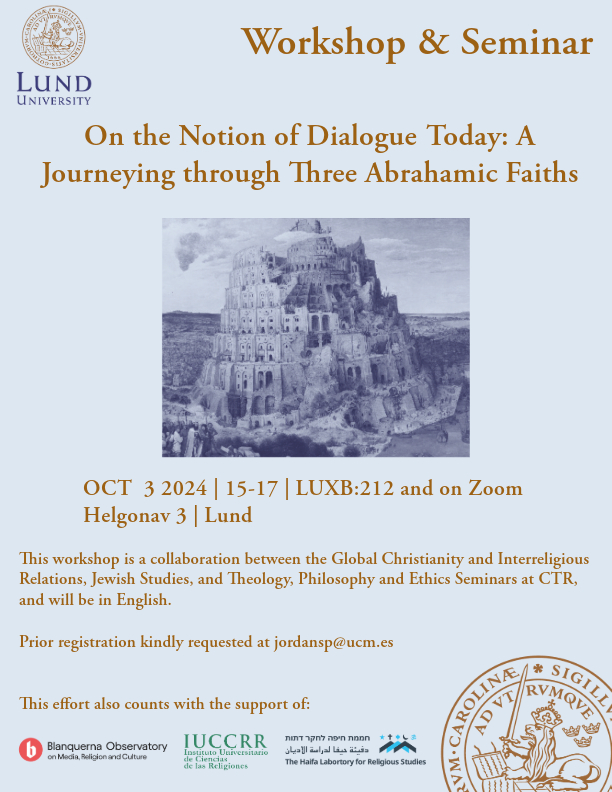
Join us 15-17.00 3rd of October in the workshop and seminar “On the Notion of Dialogue Today: A Journeying through Three Abrahamic Faith”, led by Jordan Spencer Jacobs, visiting PhD student.
In an era marked by polarization, the civil exchange of contrasting views appears to be at a crossroads. Accepting such a premise at face value, what insights may we glean from the three Abrahamic faith traditions, and particularly, what may they suggest about “dialogue,” “disagreement,” and “difference” today? To explore such questions, in this Seminar and Workshop we will study short textual excerpts together from the three Abrahamic faiths, and when appropriate, brief selections from more “secular” and contemporary philosophical thinkers. This Workshop will be in English and will be held in person and also via Zoom. To register please write to jordansp@ucm.es. Short, optional, readings will be provided via email.
The workshop is in collaboration between the Global Christianity and Interreligious Relations, Jewish studies, and Theology, Philosophy, and Ethics seminars at Centre for Theology and Religious Studies at Lund University, and the Blanquerna Observatory on Media, Religion and Culture, lUCCRR: lnstituto Universitario de Ciencias de las Religiones, and The Haifa Labortory for Religious Studies.
Please preregister to Jordan Spencer Jacobs on email: jordansp@ucm.es

CTR together with the UCL Hebrew and Jewish Studies organises a hybrid conference for postgraduate students working in the area of Jewish Studies in Nordic countries, 16th of September 2024 09:00 to 17th of September 2024 19:00. For more information, click here. The call for papers is closed, but you can still register for participation.
If you have questions or concerns, please contact the organisers Noa Ben-David (uclhben@ucl.ac.uk) and Magdalena Dziaczkowska (magdalena.dziaczkowska@ctr.lu.se).
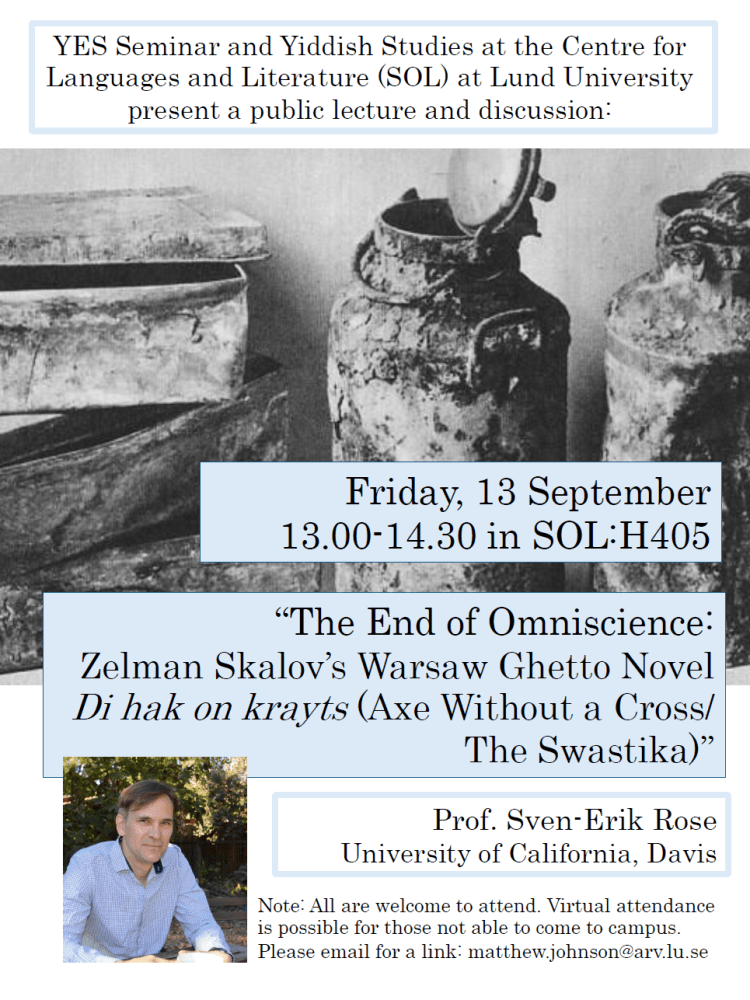
Please join us for an event with Prof. Sven-Erik Rose, who will soon be visiting Lund from the University of California, Davis. Erik will give a public lecture on Friday, 13 September, 13.00-14.30 in SOL:H405. The talk will be followed by opportunities for questions.
The talk is titled “The End of Omniscience: Zelman Skalov’s Warsaw Ghetto Novel Di hak on krayts (Axe Without a Cross/ The Swastika).” It is based on his forthcoming book about Yiddish literature produced in ghettos and camps during the Holocaust.
For people interested in participating but unable to attend on campus, there will be a virtual option (please email Matthew Johnson for a Zoom link, ideally at least one hour before the event begins).
Please click here to read more on professor Rose’s research

Are you in the area around Lund and wish to get more involved in the Jewish Studies network at Lund University? We gather a few times per semester to very informally share our lunch hour, primarily to socialise but also to discuss any questions that may arise, and we’d like to invite you to join us! Your educational level does not matter as we are everything from BA students to associate professors, and neither does your academic interest as long as it pertains to something Jewish: we are interested in everything from rabbinic texts to Jewish music, teachers of modern Hebrew and Yiddish to students of second temple Judaism. Please email Karin Zetterholm to sign up and find out more: please remember to not share the location for the safety of our Jewish participants, and as this is a strictly informal event. Below, you find the dates for this semester and you are welcome to join all and any of them.
Sept 19th 12-13
Oct 8th 12-13
Nov 12th 12-13
Dec 10th 12-13
Please remember to bring your lunch box, or get lunch at the cafeteria at LUX – the queues get quite long so please take that into account.
We look forward to seeing you there!
Conference 16 September 2024 09:00 to 17 September 2024 19:00
We encourage creative proposals centering on Jewish ideas, objects, individuals, and communities in the broad Nordic region. Call for papers is open until June 21, 2024.
CTR together with the UCL Hebrew and Jewish Studies organize a hybrid conference offering an opportunity for postgraduate students working in the area of Jewish Studies in Nordic countries to engage in meaningful discussions, form a network, and present their research. The event is an interdisciplinary conference dedicated to the study of Jewish histories, cultures, and languages across the Nordic region.
The past few years have seen a growing recognition in the academic community of the need for intellectual forums which can be accessed irrespective of location or financial means. Our event will meet this demand, providing an online platform where postgraduate and early career researchers working on some aspect of Jewish life in Scandinavia can build connections and share research in a fruitful and encouraging environment. You can register to the conference here.
This year’s pilot will be completely live and online, comprising panels of 20-minute papers and discussion. We seek to bring together researchers from across departments and universities, to form a sense of fellowship in our interdisciplinary field. To help participants meet and connect with one another, the event will offer plenty of opportunities for virtual socialising.
Our key note speakers will be: Prof. Lily Kahn, Dr. Riitta Valijärvi, UCL and Dr. Jon Reitan, NTNU.
We encourage creative proposals centring on Jewish ideas, objects, individuals, and communities in the broad Nordic region. Areas of interest include, but are not limited to:
Please submit a 200 word abstract and a short biographical note to Noa Ben-David (uclhben@ucl.ac.uk) and Magdalena Dziaczkowska (magdalena.dziaczkowska@ctr.lu.se) by June 21, 2024. Feel free to get in touch with either one of us, if you have any questions.
Please note the change of the dates of the conference!
Bat Chen (Laila) Seri, PhD student at Lund University
Walter Benjamin’s reading of Franz Kafka—laid out in three essays and many additional fragments—is replete with references to Jewish literature, from citations of alleged talmudic passages and hasidic stories to invocations of rabbinic categories. On one such notable occasion, Benjamin characterises Kafka’s works as bearing “a similar relationship to doctrine [Lehre] as the haggadah does to the halakhah.” Benjamin’s comment sets the stage for this research project, which addresses the dynamics of law and narrative in Benjamin’s reading of Kafka by setting it against the backdrop of rabbinic hermeneutics. Through contemporary rabbinic literary studies, the talmudic text is taken as a model for Benjamin’s reading of Kafka in two separate but interconnected aspects: methodically, addressing modes of reading and interpretation, and conceptually, focusing on the categories of law (halakhah) and narrative (haggadah). Viewed as talmudic hermeneutical practice, midrash has several unique characteristics, thus dictating a certain, and at times eccentric, way of thinking. Midrashic methods include the utilisation of fiction as an interpretive tool (Boyarin 2003), the exchange of one story for another of equal significance, a kind of textual barter (Boyarin 2011), and the use of imagery concepts instead of abstract concepts in a way that resembles literary texts more than legislative systems (Handelman 1982). Both Kafka and Benjamin, as scholars have pointed out (Boyarin 1990, Alter 1991, Handelman 1991, Steiner 2003, Miron 2019), show some close affinities with talmudic methods of reading, a tendency which comes to full fruition in Benjamin’s reading of Kafka, where we find the interpretive exchange of stories, the use of imagery concepts in place of abstractions, and the view of the text as a boundless repertoire of quotations, where every bit of text may be torn out of its original context as parole and be used as langue. This research project aims to show how the literary study of Talmud can serve as a guide on how to read Benjamin on Kafka and illuminate hitherto hidden aspects in the thought of two of the most thought-provoking voices of twentieth-century European Jewry on issues of law, literature, and Jewish tradition.
Would you like an abstract of your research published here? Here are our Author Guidelines! We happily welcome your contribution.
Magdalena Dziaczkowska, Postdoctor at Lund University
The purpose of the study is to understand how Jewish-Catholic couples experienced in everyday life being in a mixed marriage in a period of intense intergroup tensions (antisemitism and the Holocaust), and this purpose could be divided into five aims. Firstly, to understand the internal dynamic of a mixed couple in times of conflict. Secondly, to describe the differences in the experience of men and women and their gender roles in this setting. Thirdly, to grasp the relation of the spouses to their respective ingroups and then, their relation to the outgroup (their spouse’s group), both considering the gender factor. Finally, the study seeks to assess the influence of these couples on intergroup relations in their environments, as previous research suggests intermarriage is one of the most powerful tools in overcoming intergroup prejudice and tensions. These questions are considered in the timeframe of 1930’s until 1950’s, thus, the period directly preceding, encompassing, and following the Holocaust. The study will follow the experiences of these couples throughout the entire period (the chronological aspect being crucial), and will be limited to the Polish citizens, who either stayed in Poland or left for Sweden, Israel after the war. Specific research questions following these aims are:
The project is realized within the framework of an International Postdoc financed by the Swedish Research Council. The administrating institution is Centre for Theology and Religious Studies at Lund University and the host institutions are: Hebrew University of Jerusalem, University of Haifa, Jagiellonian University, and Inez and Julius Polin Institute for Theological Research at Åbo Akademi.
Would you like an abstract of your research published here? Here are our Author Guidelines! We happily welcome your contribution.
Deadline for application is May 15, 2024. For more information, please see, https://lu.varbi.com/en/what:job/jobID:717701/
The Case of the Pseudo-Clementine Homilies
Karin Hedner Zetterholm, Associate Professor in Jewish Studies at Lund University
I am currently working on the Pseudo-Clementine Homilies, a composite text redacted in the early fourth century that gives the impression of being both Jewish and Christia at the same time. The author/redactor prescribes a lifestyle for non-Jewish followers of Jesus based on the laws that according to Leviticus are binding on non-Israelites living among the Israelites in the land of Israel and presents adherence to Jesus as being in continuity with the teachings of Moses. He envisions two parallel lifestyles and paths to salvation, one for Jews through Moses and one for non-Jews through Jesus (an ideal text for interfaith dialogue!).
The Homilies are by most scholars seen as a Christian work and is studied as part of the history of (heretical) Christianity but given recent scholarship on the diversity within Judaism also after the fall of Jerusalem in 70 and the rabbinic movement’s slow ascent to power, one could argue that it should be included in the history of Judaism as well. Some scholars have convincingly demonstrated that at least some authors saw belief in Jesus as an orientation within Judaism as late as the fourth and even fifth century, and the discussion has moved on to attempts at establishing criteria for determining which texts, previously considered Christian, may rather be placed “within Judaism.” These efforts are highly significant for the scholarly reconstruction of the history of both Christianity and Judaism and have the potential to change our perception of them both. While rabbinic Judaism was earlier seen as the sole standard by which Jewishness was measured, the insight that Judaism in the early centuries CE was much more diverse than previously thought has led scholars to consider an increasing number of non-rabbinic texts as potential sources of information about Jews and Judaism in antiquity. In time, this will lead to a reassessment of what constituted Judaism (and Christianity) during the early centuries CE.
Would you like an abstract of your research published here? Here are our Author Guidelines! We happily welcome your contribution.